What you will learn
- 1The features of prokaryotic cells such as bacteria
- 2The features of eukaryotic cells such as plant, animal and fungal cells
- 3The key differences: size, DNA, organelles, ribosomes and how they reproduce
- 4How bacteria share plasmids by conjugation
Read
01
Prokaryotes
- Small cells (typically 1–5 µm).
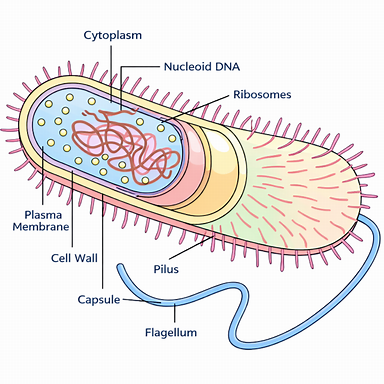
- No nucleus — DNA is free in the cytoplasm (nucleoid region).
- No membrane-bound organelles (no mitochondria, chloroplasts, ER, Golgi).
- Usually unicellular (bacteria, archaea).
- Circular DNA; may have plasmids.
- Simple cell structure with cell wall, cell membrane, cytoplasm, ribosomes (70S).
- Reproduce by binary fission (simple, fast).
- Conjugation is a process that takes place in bacteria, in which a donor bacterium transfers genetic material—usually a plasmid—to a recipient bacterium through a conjugation pilus, resulting in new genetic combinations.
- Conjugation occurs when a donor bacterium carrying a conjugative plasmid (such as an F-plasmid) forms a conjugation pilus and comes into direct contact with a recipient cell lacking that plasmid.
- Often have flagella, pili, or capsules for movement and protection.
02
Eukaryotes
- Larger cells (typically 10–100 µm).
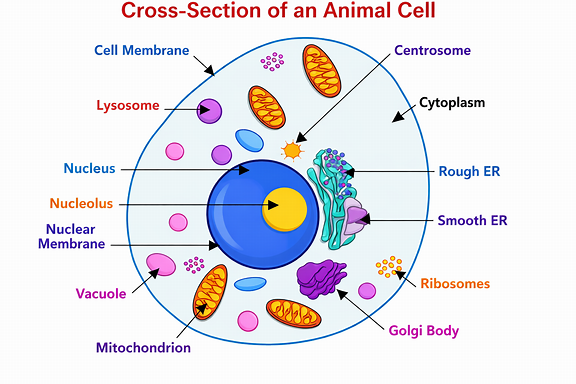
- Nucleus present — DNA enclosed within a nuclear membrane.
- Membrane-bound organelles (mitochondria, chloroplasts, ER, Golgi, lysosomes).
- Can be unicellular or multicellular (plants, animals, fungi, protists).
- Linear DNA arranged into chromosomes.
- Complex cell structure with cytoskeleton.
- Ribosomes are 80S.
- Reproduce by mitosis (and meiosis in sexual reproduction).