Cell Biology
The fundamental unit of life
Cell biology is the branch of biology that studies the structure, function, and behaviour of cells, the basic units of life.
Nucleus — contains DNA that controls the cell
Explore every subtopic
Hover a card to bring its cells to life. Each one has notes, Bio-Diagrams, key terms and exam questions.
Animal and Plant Cells & Cell Organelles
The cell membrane is a phospholipid bilayer that forms the outer boundary and controls the entry and exit of substances.
Prokaryotes and Eukaryotes
Small cells (typically 1–5 µm).
Differentiation and Specialization
Differentiation is the process by which unspecialized stem cells become specialized cells with distinct structures and functions.
Microscopy
Magnification: How many times larger the image is compared to the actual object.
Cell Culture
Cell culture is the technique of growing living cells outside the body in controlled laboratory conditions so scientists can study, test, and manipulate them
Cell Division
Cell division is essential for: Growth – increasing the number of cells in an organism.
Stem Cells
Stem cells are undifferentiated, self-renewing cells that can develop into specialised cells.
Cell Transport
Diffusion: Net movement of particles from high concentration to low concentration down the concentration gradient.
Topic overviewShow
Cell biology is the branch of biology that studies the structure, function, and behaviour of cells, the basic units of life.
- Cells as the basic unit of life — All organisms are made of cells, whether single-celled (like bacteria) or multicellular (like plants and animals).
- Cell structure — Includes studying organelles such as the nucleus, mitochondria, ribosomes, and chloroplasts.
- Cell function — How cells grow, divide, produce energy, communicate, and carry out specialized roles.
- Cell types — Prokaryotic (bacteria, archaea) and eukaryotic (plants, animals, fungi, protists).
Cell theory was proposed by,
- Matthias Schleiden (1838) — A German botanist who concluded that all plant tissues are made of cells.
- Theodor Schwann (1839) — A German physiologist who observed that animal tissues are also made of cells, unifying plant and animal observations into one theory.
- Rudolf Virchow (1855) — Later added the principle “omnis cellula e cellula” (all cells arise from pre-existing cells), strengthening modern cell theory.
Cell theory states that,
- All living organisms are made of one or more cells.
- The cell is the basic unit of structure and function in living things.
- All cells come from pre-existing cells through cell division.
- Cells contain genetic material (DNA) that is passed to new cells.
- Cells carry out metabolism (chemical reactions needed for life).
Significance of cell biology
- Understanding cells helps explain how organisms grow, repair damage, reproduce, and respond to their environment.
- It is also essential for fields like genetics, medicine, cancer research, immunology, and biotechnology.
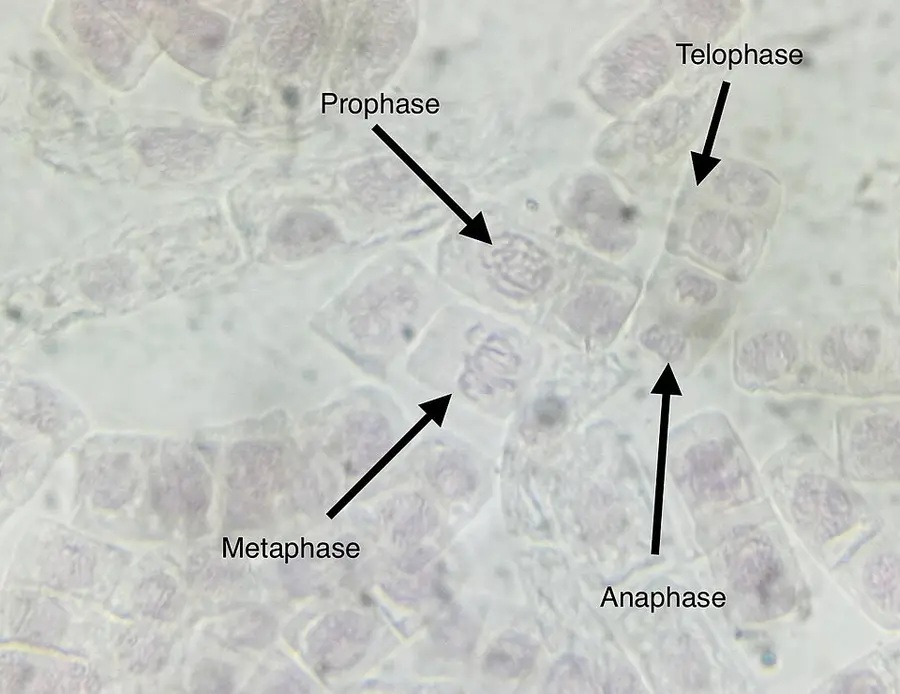 Light microscope · stained · ≈ ×400
Prophase, metaphase, anaphase and telophase, all in one field of view.
Root tips are used for mitosis practicals because cells there divide constantly.
Ibn Anvar · CC0