What you will learn
- 1The structures in animal and plant cells and what each one does
- 2How the main organelles work: nucleus, ribosomes, ER, Golgi apparatus, lysosomes, mitochondria and cell membrane
- 3The parts found only in plant cells: chloroplasts, the central vacuole and the cellulose cell wall
Read
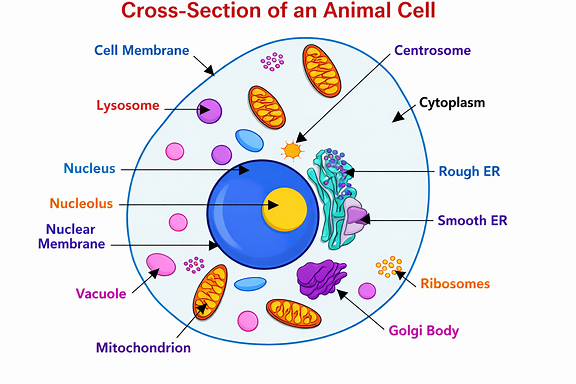
Animal Cell
- The cell membrane is a phospholipid bilayer that forms the outer boundary and controls the entry and exit of substances.
- Cytoplasm contains organelles and is the site of most metabolic reactions.
- Nucleus stores DNA and regulates all cell activities.
- Mitochondria carry out aerobic respiration and release usable energy.
- Ribosomes synthesize proteins for growth and repair.
- Endoplasmic reticulum (ER) transports proteins and lipids within the cell.
- Golgi apparatus modifies, packages, and secretes cell products.
- Lysosomes contain enzymes for digestion of waste and damaged organelles.
- No cell wall, no chloroplasts, and no large central vacuole.
Plant Cell
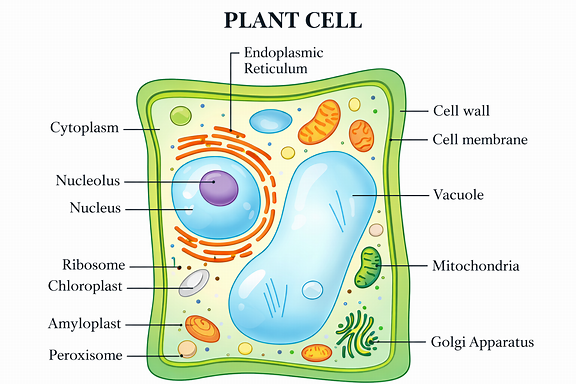
- Cell wall (cellulose) provides rigidity, protection, and fixed shape.
- Cell membrane lies beneath the cell wall and controls movement of substances.
- Chloroplasts contain chlorophyll and perform photosynthesis.
- Large central vacuole maintains turgor pressure and stores water and solutes.
- Nucleus controls cell functions and stores genetic material.
- Cytoplasm supports organelles and metabolic reactions.
- Mitochondria release energy through aerobic respiration.
- Ribosomes, ER, and Golgi apparatus function similarly to animal cells.
- Typically, rectangular or box-like due to the rigid cell wall.
Cell organelles in detail
A cell works like a miniature factory. Each organelle is a specialised structure with a precise function that keeps the cell alive, organised, and efficient.
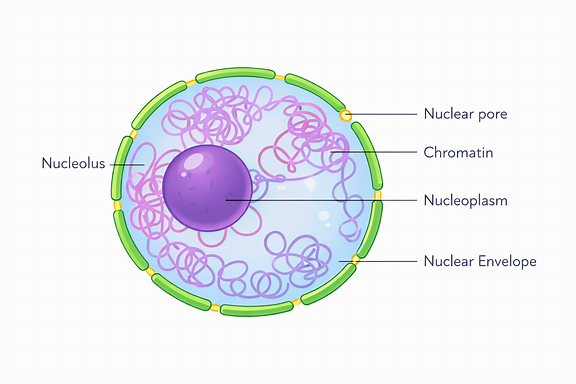
Nucleus — Control Centre
- Contains DNA, the genetic blueprint.
- Controls cell activities, growth, and protein synthesis.
- Surrounded by a nuclear envelope with pores for material exchange.
- Contains nucleolus, which makes ribosomes.
Ribosomes — Protein Factories
- Sites of protein synthesis.
- Found free in cytoplasm or attached to rough ER.
- Free ribosomes make internal proteins; bound ribosomes make exported proteins.
Endoplasmic Reticulum (ER) — Transport Network
- Rough ER: Has ribosomes; modifies and transports proteins.
- Smooth ER: Makes lipids, detoxifies chemicals, stores calcium.
Golgi Apparatus — Packaging and Distribution
- Receives proteins/lipids from ER.
- Modifies, sorts, and packages them into vesicles.
- Forms lysosomes and secretory vesicles.
Lysosomes — Digestive Units (Animal Cells)
- Contain enzymes to break down waste, damaged organelles, and pathogens.
- Important for cellular clean-up and recycling.
Mitochondria — Powerhouse
Structure of Mitochondria:
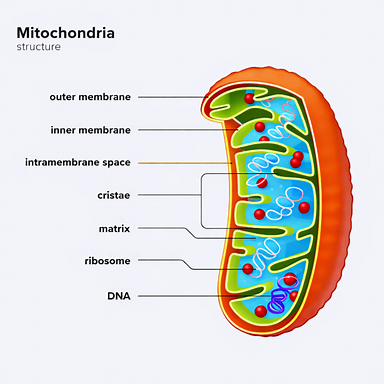
- sausage-shaped or cylindrical. It has its own DNA
- Double membrane:
- Outer membrane — smooth, contains porins (VDAC) allowing passage of small molecules.
- Inner membrane — highly folded into cristae, rich in cardiolipin, impermeable to ions, and houses enzymes of the electron transport chain and ATP synthase.
- Intermembrane space:
- Lies between outer and inner membranes; important for proton gradient formation.
- Cristae: Finger-like or plate-like infoldings that increase surface area for oxidative phosphorylation.
- Matrix: Contains mitochondrial DNA (mtDNA), 70S ribosomes, enzymes of the Krebs cycle, ions, and Ca²⁺ granules.
- Site of aerobic respiration.
- Produces ATP, the cell’s energy currency.
Cell Membrane — Boundary and Gatekeeper. Mainly made up of phospholipid bilayer.
Phospholipids have hydrophilic (water-loving) head, oriented toward aqueous environment and hydrophobic (water-fearing) tails, tucked inside the membrane.
Phospholipid bilayerhas different type ofproteins.(act as channel protein, transport protein and receptor protein and peripheral protein)and alsocholesterol, glycolipids and glycoproteins. Fluidity of the membrane is maintained by cholesterol and kink nature of unsaturated fatty acids tail which prevents tight packing of molecules. Given below is fluid mosaic model of plasma membrane.

- Functions of cell membrane:
- Controls entry and exit of substances.
- Maintains homeostasis.
Cytoplasm — Site of Reactions
- Jelly-like medium where organelles are suspended.
- Many metabolic reactions occur here.
- Plant-Specific Organelles
Chloroplasts
Structure of Chloroplasts: lens-shaped. It has its own DNA and ribosomes for protein synthesis.
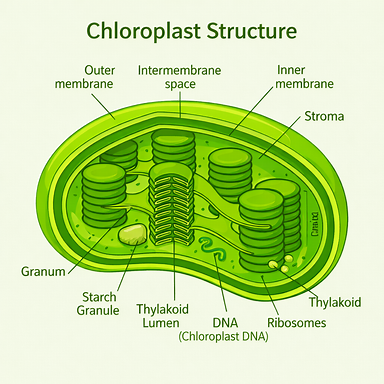
- Double membrane: Outer membrane and inner membrane. Space between them is the intermembrane space.
- Stroma: Dense fluid containing enzymes (e. g., RUBISCO), DNA, ribosomes, and starch grains; site of dark reactions.
- Thylakoids: Flattened membrane sacs containing chlorophyll, carotenoids, photosystems I & II, cytochromes, and ATP synthase.
- Grana: Stacks of thylakoids resembling coins; increase surface area for light absorption.
- Stroma lamellae: Membranous bridges connecting grana; maintain continuity of thylakoid system. Site of photosynthesis. Contain chlorophyll to trap light energy.
- Produce glucose and oxygen.
- Central Vacuole: Large fluid-filled sac. Maintains turgor pressure, stores water, ions, pigments.
Cell Wall: Made of cellulose. Provides rigidity, protection, and shape.
Additional Organelles:
Centrioles (animal cells) — organise spindle fibres during cell division.
Peroxisomes — break down toxic substances like hydrogen peroxide.
Vesicles — transport materials within the cell.