What you will learn
- 1Diffusion and what affects its rate
- 2Facilitated diffusion
- 3Osmosis, tonicity and how plant and animal cells respond
- 4Active transport
- 5Surface-area-to-volume ratio and the osmosis required practical
Read
01
Diffusion
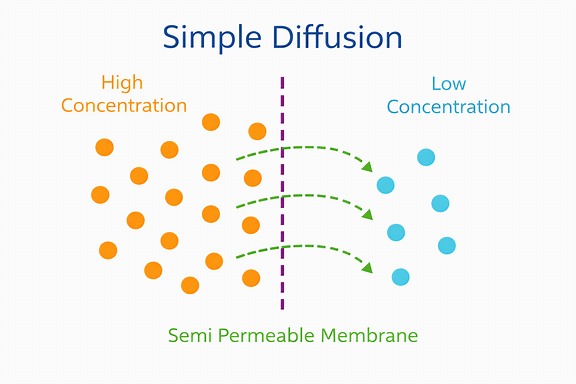
- Diffusion:
- Net movement of particles from high concentration to low concentration down the concentration gradient.
- Passive process — no ATP required.
- Occurs due to random movement of particles.
- Factors increasing rate of diffusion:
- Steeper concentration gradient
- Higher temperature
- Larger surface area
- Shorter diffusion distance
- Examples: oxygen into cells, CO₂ out of leaf cells, glucose in small intestine.
02
Facilitated diffusion
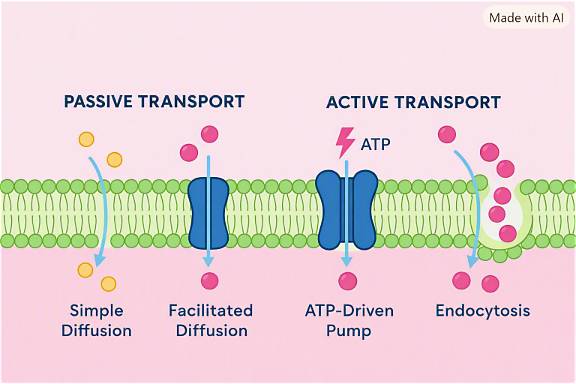
- Movement of substances down their concentration gradient
- (from high to low concentration).
- No energy (ATP) required because it is a passive process.
- Transport occurs through channel proteins or carrier proteins embedded in the membrane.
- Channel proteins form hydrophilic pores allowing specific ions or polar molecules to pass.
- Carrier proteins undergo a shape change when the correct molecule binds, helping it cross the membrane.
- Transport is highly selective — each protein transports only certain molecules (e. g., glucose, amino acids, ions).
- Rate of facilitated diffusion shows saturation: once all carrier proteins are occupied, increasing concentration does not increase rate.
- Allows cells to take in substances that cannot diffuse through the phospholipid bilayer (large, polar, or charged molecules).
- Temperature affects rate because protein movement and molecular kinetic energy change.
- Important in processes like glucose uptake in muscle cells via GLUT transporters.
- TONICITY: — the relative solute concentration of a solution compared to the inside of a cell, which determines the direction of water movement during osmosis.
- Hypertonic — higher solute concentration outside the cell → water moves out of the cell.
- Hypotonic — lower solute concentration outside the cell → water moves into the cell.
- Isotonic — equal solute concentration inside and outside → no net water movement.
- These terms explain how cells behave in different solutions — swelling, shrinking, or staying the same — because osmosis always moves water toward the side with more solute.
03
Osmosis
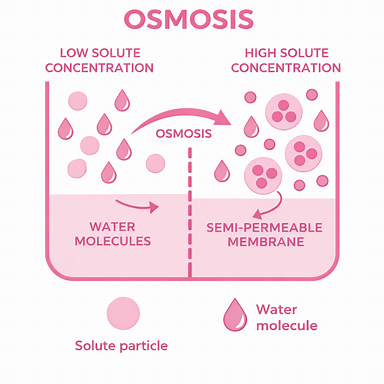
- Osmosis is defined as net movement of water molecules from a dilute solution to a concentrated solution through a partially permeable membrane.
- It is a passive process.
- Only water moves through a partially permeable membrane.
- Water moves from high water potential to low water potential.
- Examples:
- Water entering root hair cells
- Water entering red blood cells in dilute solutions
- Plant cell responses:
- Turgid: Water enters; membrane presses against wall when placed in dilute (hyptonic) solution.
- Flaccid: Water leaves; cell softens when placed in concentrated (hypertonic) solution.
Plasmolysis: In very concentrated solution; membrane pulls away from wall.
- Animal cell responses:
- Haemolysis: water diffuses into red blood cells and cause swelling and bursting when placed in a dilute (hypotonic).
- Crenation: water is drawn out, causing the cells to shrivel and shrink when the cells are placed in a concentrated (hypertonic) solution.
04
Active transport
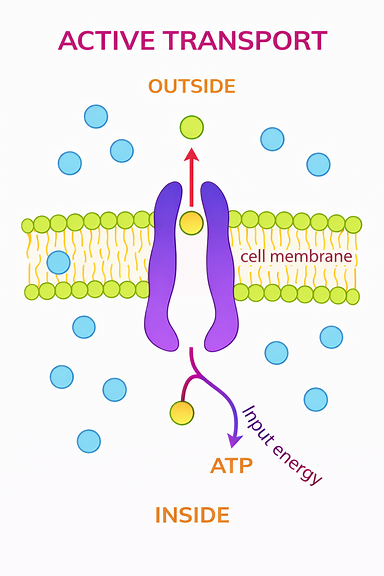
- Definition: Movement of particles against the concentration gradient (low → high) using energy (ATP) from respiration.
- Requires carrier proteins in the membrane.
- Requires ATP from mitochondria.
- Cells that do lots of active transport have many mitochondria.
- Examples: Root hair cells absorbing mineral ions from dilute soil
- Gut lining absorbing remaining glucose into blood that already has higher concentration
05
Comparision of all cell transport
| Process | Direction | Energy | What Moves | Membrane Needed? |
|---|---|---|---|---|
| Diffusion | High → Low | No | Any particles/gases | No |
| Osmosis | Dilute → Concentrated | No | Water only | Yes (partially permeable) |
| Active Transport | Low → High | Yes (ATP) | Specific molecules/ions | Yes (carrier proteins) |
06
surface-area-to-volume Ratio (SA: V)
- Smaller organisms or cells with large SA: V exchange substances faster.
- Larger organisms need specialised exchange surfaces (lungs, gills, villi).
- Thin membranes + good blood supply + ventilation increase transport efficiency.
- Required practical (osmosis in potato tissues)
- Measure mass before and after placing potato cylinders in solutions of different concentrations.
- % change in mass = (Final − Initial) ÷ Initial × 100
- Positive % = water gained; negative % = water lost.