What you will learn
- 1What differentiation and specialization mean
- 2Why selective gene expression makes cells different
- 3Stem cell potency: totipotent, pluripotent and multipotent
- 4Examples of specialized animal and plant cells
Read
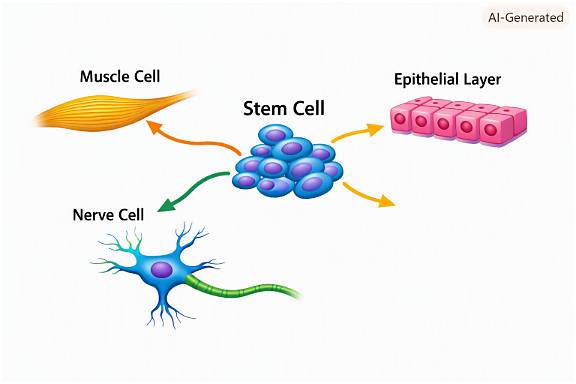
- Differentiation is the process by which unspecialized stem cells become specialized cells with distinct structures and functions.
- Specialization is the final state of these differentiated cells, enabling them to perform specific roles
- (e. g., contraction, oxygen transport, signal transmission).
- All cells have identical DNA; specialization occurs through selective gene expression.
- Internal factors (transcription factors, asymmetric division) and external signals guide differentiation.
01
Significance of differentiation and specialization
- Allow formation of tissues and organs during development.
- Enable growth, repair, and replacement of cells.
- Ensure organisms have a wide variety of functional cell types.
02
Stem Cell Potency
- Potency determines how many different cell types a stem cell can become.
- Totipotent — can form all cell types including placenta (zygote).
- Pluripotent — can form almost all body cells (embryonic stem cells).
- Multipotent — limited to specific tissue types (e. g., blood stem cells).
- Faulty differentiation can lead to cancer, congenital disorders, and impaired tissue repair.
03
Some examples of specialized cells
- Red blood cells — carry oxygen; no nucleus.
- Neurons — transmit electrical impulses.
- Muscle cells — contract using actin and myosin.
- Guard cells (plants) — regulate stomatal opening.
- Sperm cells – fertilize egg