What you will learn
- 1Why cells divide
- 2The cell cycle: G1, S, G2 and M phase
- 3The stages of mitosis, and how meiosis is different
- 4Binary fission in prokaryotes
- 5How faulty cell-cycle control can lead to cancer
Read
- Cell division is essential for:
- Growth – increasing the number of cells in an organism.
- Repair – replacing damaged or dead cells.
- Asexual reproduction – producing genetically identical offspring (mitosis).
- Sexual reproduction – producing gametes (meiosis).
- The cell cycle describes the life of a cell from one division to the next. It has two major parts:
- Interphase: growth phase 1 to synthetic phase to growth phase
01
(G1 → S → G2)
Most of the cell’s life is spent here.
G1 (Gap 1): Cell grows; organelles increase.
S (Synthesis): DNA replicates → each chromosome forms two identical chromatids.
G2 (Gap 2): Further growth; proteins for mitosis produced; DNA checked for errors.
02
M Phase (Mitosis + Cytokinesis)
- Mitosis: Division of the nucleus.
- Cytokinesis: Division of the cytoplasm → two identical daughter cells.
03
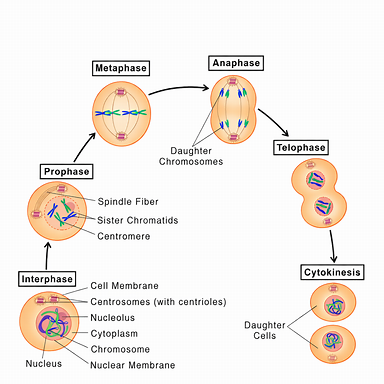
Mitosis
- Purpose: Growth, repair, asexual reproduction. Outcome: Two genetically identical diploid cells (same number of chromosomes as parent).
- Stages of mitosis:
- Prophase: Chromosomes condense; nuclear membrane breaks down.
- Metaphase: Chromosomes line up at the equator.
- Anaphase: Sister chromatids pulled to opposite poles.
- Telophase: New nuclear membranes form.
Cytokinesis: Cell splits into two identical daughter cells.
- Purpose: Production of gametes for sexual reproduction. Outcome: Four genetically different haploid cells (half the chromosome number).
- Key Features
- Meiosis I: Homologous chromosomes separate → variation from crossing over & independent assortment.
- Meiosis II: Sister chromatids separate → similar to mitosis.
| Feature | Mitosis | Meiosis |
|---|---|---|
| Number of divisions | 1 | 2 |
| Daughter cells | 2 | 4 |
| Genetic identity | Identical | Different |
| Chromosome number | Diploid → Diploid | Diploid → Haploid |
| Purpose | Growth/repair | Gamete formation |
Cell Division in Prokaryotes.
Prokaryotes divide by binary fission, not mitosis.
- DNA replicates
- Cell elongates
- Cell splits into two identical cells
- Cell Division, Cancer & Regulation:
- Mutations in regulators → uncontrolled cell division → cancer.
- There are regulatory proteins that control cell cycle.
- Their job is to make sure cells divide only when needed and stop when division is not safe.
- Key regulatory proteins include:
- Cyclins — proteins that rise and fall to control each stage of the cell cycle.
- CDKs (Cyclin-dependent kinases) — enzymes activated by cyclins to push the cell through checkpoints.
- Cancer often begins when the regulatory proteins that normally control cell division stop working properly, allowing cells to divide too fast, ignore signals, and become abnormal.
- When regulatory proteins fail:
- Cells divide without stopping
- Cells ignore signals to die (apoptosis)
- Abnormal cells accumulate
- A tumour form
- Some cells may break away and spread (metastasis)